
Why resin-bound stone must be understood as a system, not a surface
Reader Entry|Why problems appear after projects are finished
In many landscape projects, surfaces look complete long before they actually succeed.
The first complaints rarely come during installation.
They arrive months later—after handover—when drainage slows, skid resistance becomes inconsistent, colours begin to drift, or maintenance turns unpredictable.
Resin-bound stone is often chosen because it looks refined, permeable, and modern.
But what determines its success is not how it looks on day one—it is how it behaves over time.
This article is not about how to install resin-bound stone.
It is about why treating it as a “surface” increasingly leads to failure—and why it now needs to be understood, designed, and operated as a system.
1. From surface to system: a shift we often underestimate
For a long time, landscape materials were evaluated mainly by appearance.
Resin-bound stone still carries that legacy.
It is frequently discussed as a finish, a texture, or a visual choice.
But in practice, it quietly carries far more responsibility:
water movement, safety under wet conditions, thermal behaviour, ageing stability, and long-term maintenance outcomes.
In my view, this is where many projects begin to go wrong—not because the material is misused, but because its role is misunderstood.
What looks like a surface is already functioning as a system.
2. The red surface: when beauty hides the first misjudgement
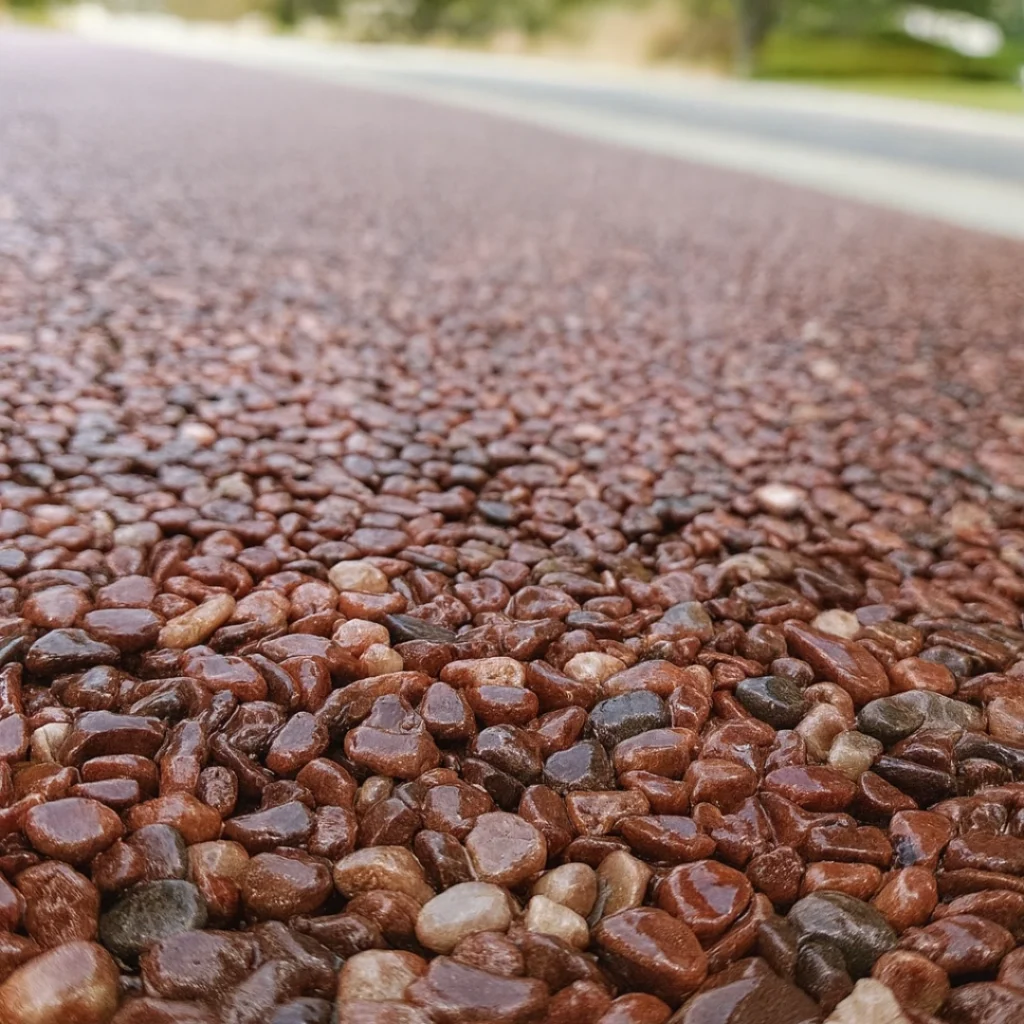
Up close, a red resin-bound surface feels effortless.
The colour is warm.
The binder is transparent.
The aggregate appears stable and refined.
This visual success often creates confidence.
And that confidence can be misleading.
What is rarely visible are the decisions beneath the surface:
void structure, binder clarity, aggregate compatibility, and how the system will age under real conditions.
One common misconception is that colour or aggregate choice is the dominant variable. In reality, structure and binder behaviour often decide whether beauty remains consistent—or fails unevenly.
This is usually the first misjudgement:
equating a successful appearance with a successful system.
3. The grey path: how everyday use becomes the real test
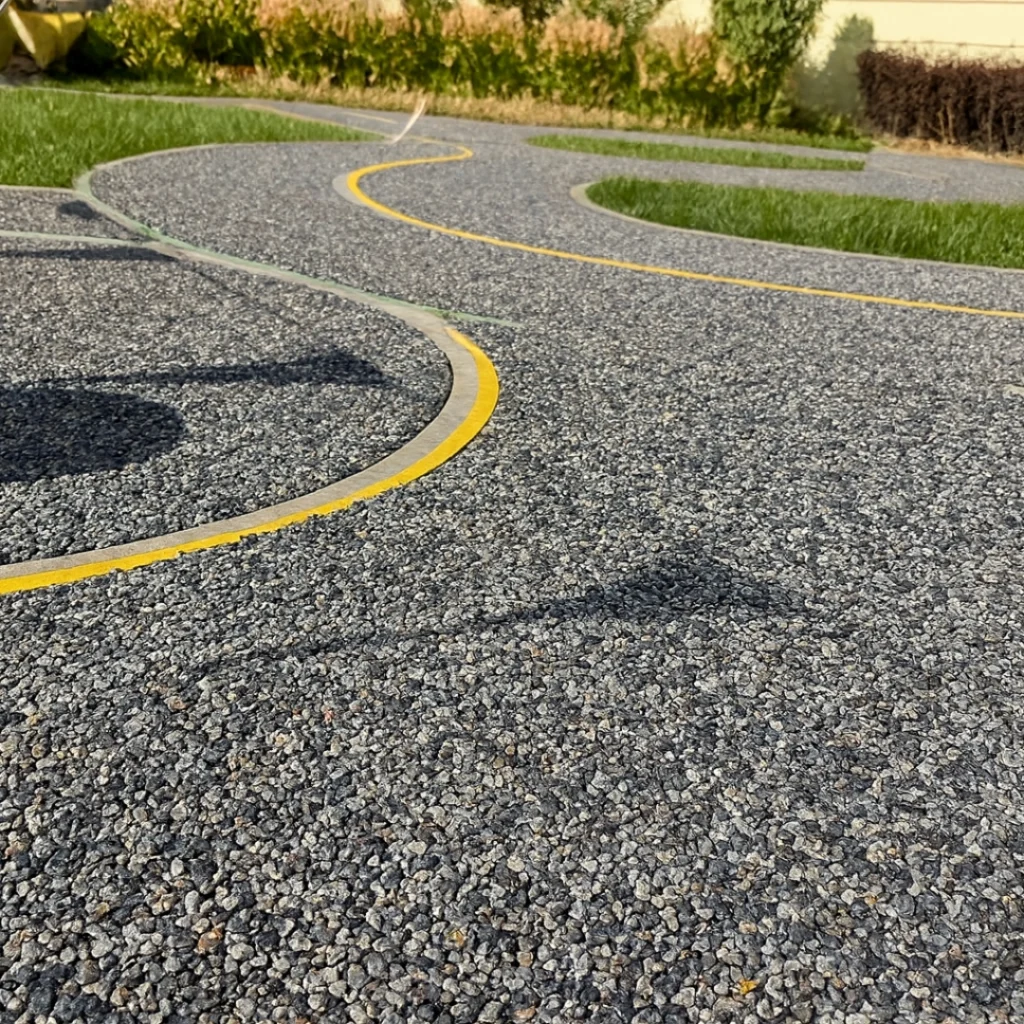
A curved grey pathway between lawns looks simple on a plan.
But once it enters daily life, everything changes.
Children run.
Bicycles cut corners.
Wheelchairs apply repeated point loads.
Rain, morning dew, and seasonal temperature cycles quietly accumulate.
Design drawings rarely describe these forces.
Yet this is where performance is actually tested.
From what I’ve seen, the first real warning signs often appear after repeated wet-dry cycles—not immediately, but gradually.
At this point, the question is no longer:
“Can it be paved well?”
It becomes:
“Can this system perform reliably under continuous, ordinary use?”
This is where a surface stops being a product and starts behaving like infrastructure.
4. The black courtyard: when precision leaves no room for error
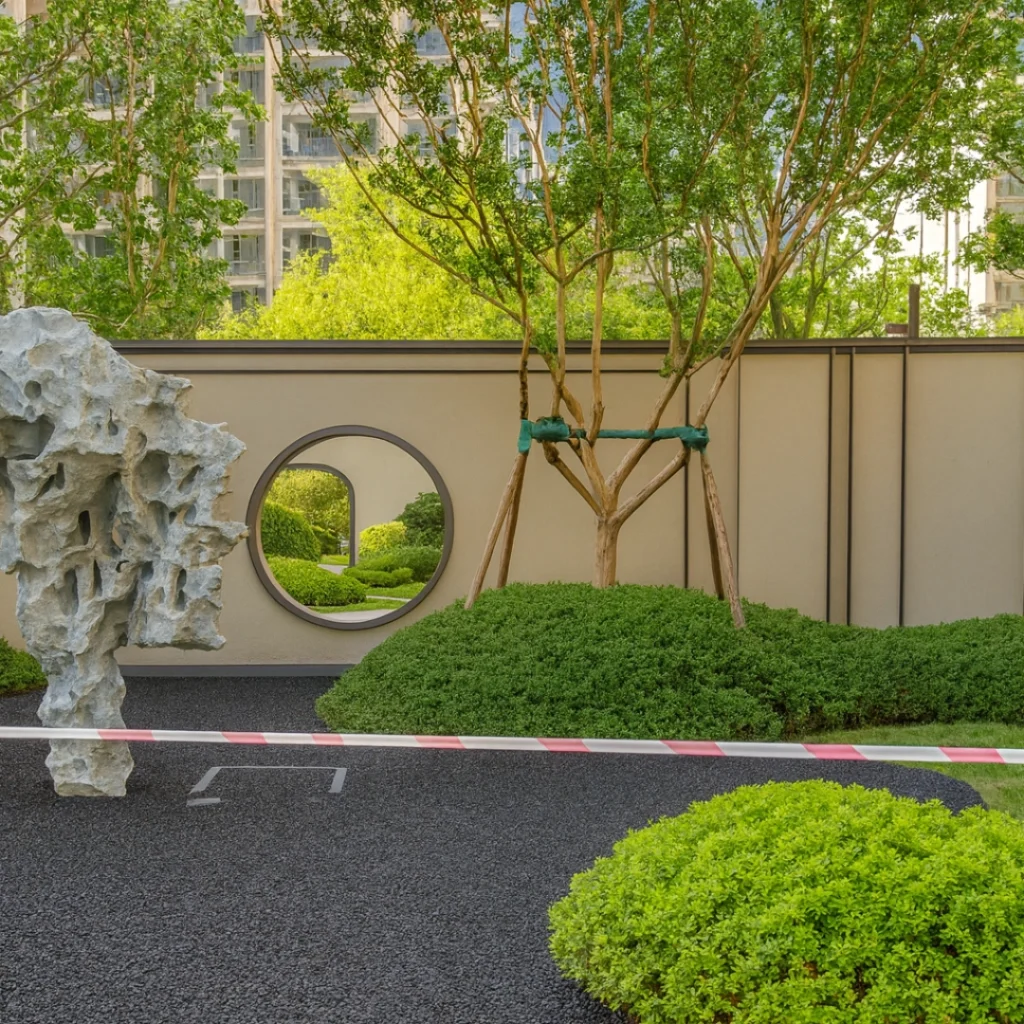
In premium courtyards and refined landscapes, tolerance disappears.
A slight colour shift becomes visible.
A micro-texture change breaks visual continuity.
A repair that fails to blend immediately draws attention.
Here, performance and aesthetics converge.
In my view, high-end projects reveal something important:
systems are not adopted because they are sophisticated, but because predictability matters more than perfection.
When maintenance outcomes are uncertain, even the most elegant surface becomes a long-term risk.
This is often the moment when system thinking stops being optional.
5. Why this is not just a material issue
What resin-bound stone is experiencing is not unique.
Across modern landscapes, materials are being asked to perform like infrastructure:
·manage water
·maintain safety
·resist ageing
·support predictable maintenance cycles
This is not misuse.
It is the result of changing expectations and longer accountability horizons.
The language shifts—from finishes to risk, from appearance to lifecycle behaviour.
Seen this way, resin-bound stone is not an exception.
It is simply revealing a broader industry transition.
6. How systems are forced into existence
When projects fail repeatedly in similar ways, engineering logic follows.
Many current system-level directions are not innovations for their own sake—they are responses to known failure patterns:
·higher-solids transparent binders address cohesion loss under moisture cycling
·balanced hardness reduces micro-raveling while allowing substrate movement
·UV-stability frameworks protect colour integrity over time
·real-condition testing exposes weaknesses before installation
·optimized binder-to-aggregate ratios balance permeability and strength
The practical point is this:
these are not features—they are answers to predictable problems.
Understanding that distinction changes how systems are evaluated.
7. The real shift: changing how we ask questions
The most important transition is not technical.
It is conceptual.
Instead of asking, “How do we pave this surface?” the more useful questions become:
·What performance drift is acceptable over time?
·How will that performance be validated?
·What does maintenance realistically look like after year two or five?
When these questions are asked early, system thinking emerges naturally.
8. Closing the loop: redefining material value
The red surface, the grey path, and the black courtyard were never just examples.
They trace a pattern.
From my perspective, resin-bound stone is not valuable because of how it looks—but because of what it exposes.
It shows that materials today are no longer standalone choices.
They are parts of systems with long-term consequences.
Materials are tools.
Systems are the product.
And systems must be designed as a whole.
This is the quiet but fundamental upgrade shaping modern landscape engineering.