
When we first started working with colored permeable asphalt, the logic seemed straightforward.
As long as the color, permeability, and skid resistance met the requirements, using a hot-mix system felt like the default choice.
Problems rarely appeared at the design stage.
They usually surfaced later—during construction.
The issue was not that the work could not be done, but that it became increasingly difficult to manage
Those projects shared a common trait:
they were not large, yet they were highly fragmented.
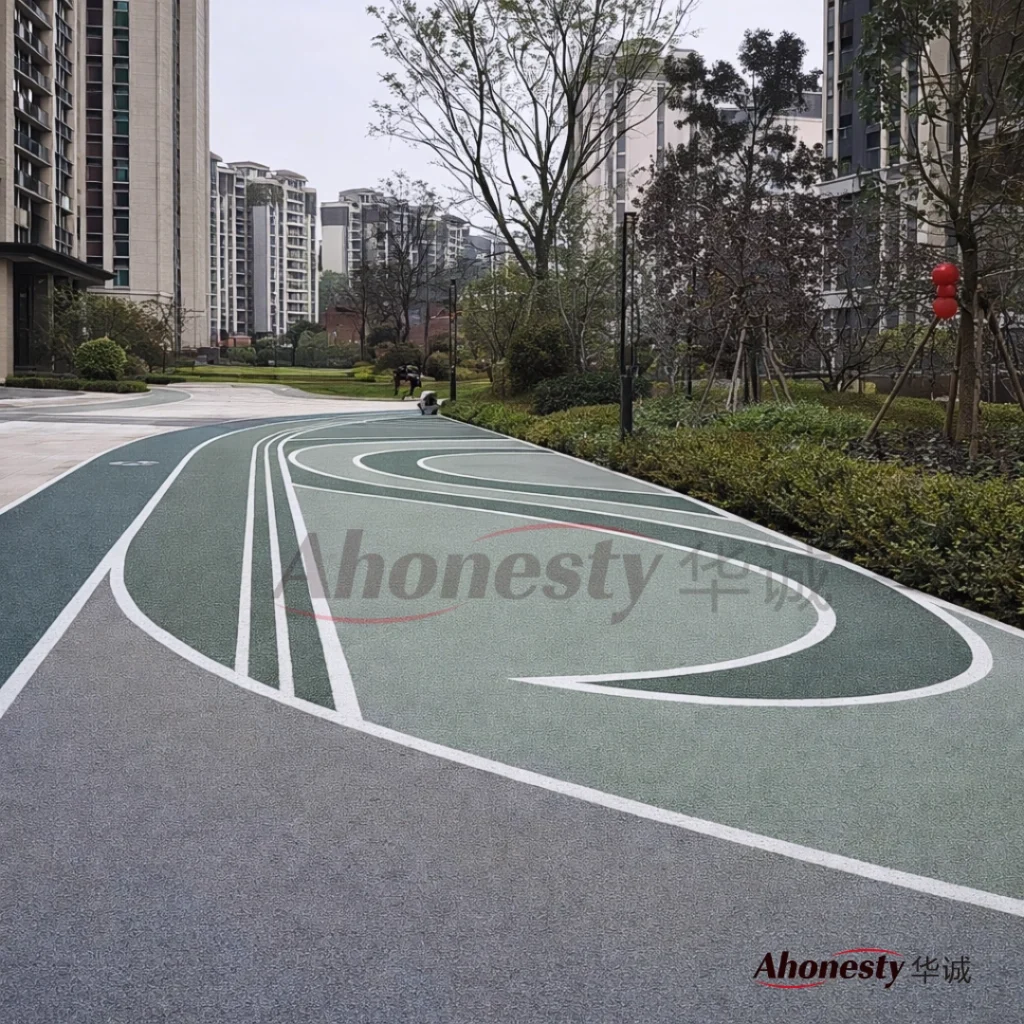
Some were residential or campus pedestrian systems, where a single path was broken into multiple sections by landscaping and nodes.
Others were park walkways that had to be coordinated with different trades, requiring repeated entry and exit from the site.
In some cases, the construction schedule inevitably crossed seasonal boundaries.
Individually, none of these segments were technically challenging.
What made them difficult was forcing all of these fragmented scenarios into a hot-mix construction framework.
At that point, discussions shifted away from material performance and toward questions such as:
Can the mixing plant be scheduled?
Does the transport distance fit the temperature window?
Is it reasonable to mobilize repeatedly for such limited paving areas?
That was when the problem became clear.
When the scenario changes, but the system does not
Looking back at these projects, the issue itself was not complicated.
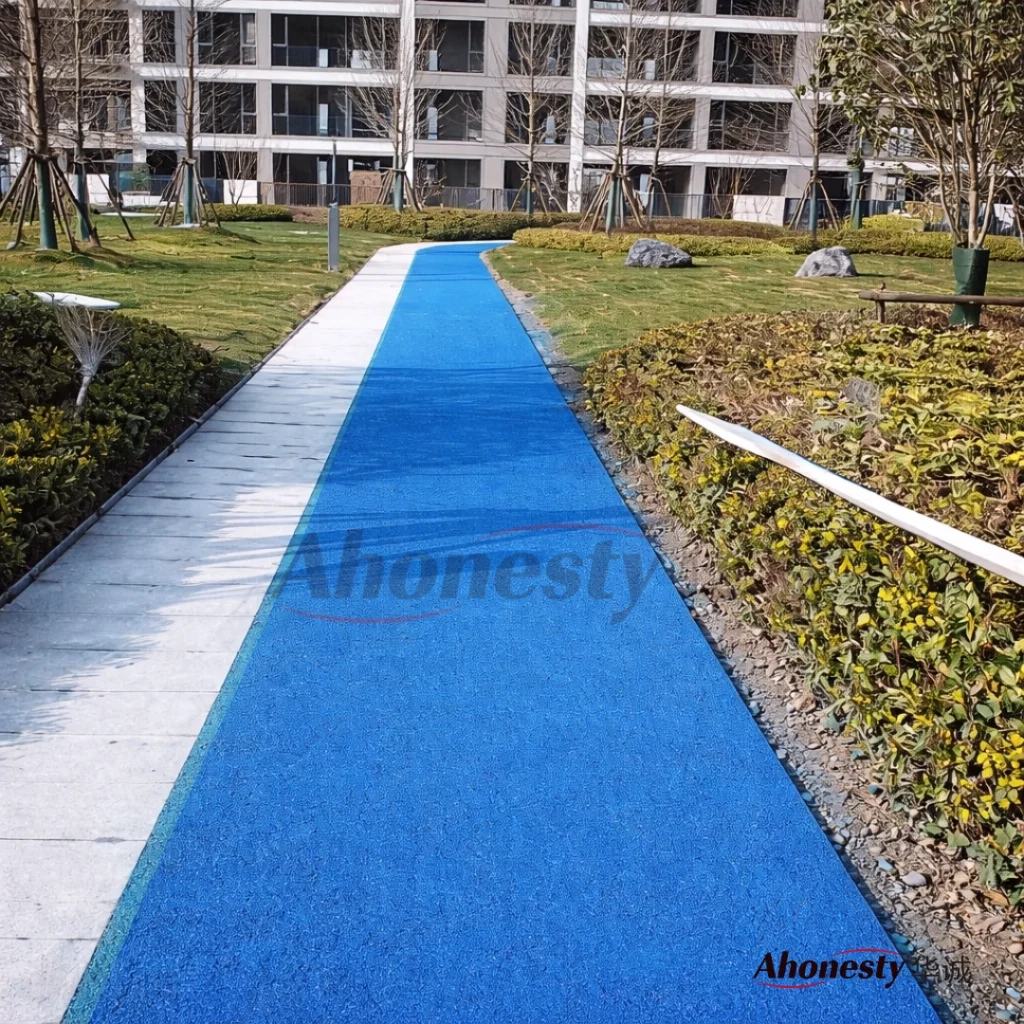
In settings such as park greenways, residential walkways, and parking areas, colored permeable asphalt is rarely expected to function as a structural road layer.
It behaves more like a functional pavement interface:
- guiding pedestrian movement,
- defining spatial zones,
- balancing visual order, walking comfort, and safety.
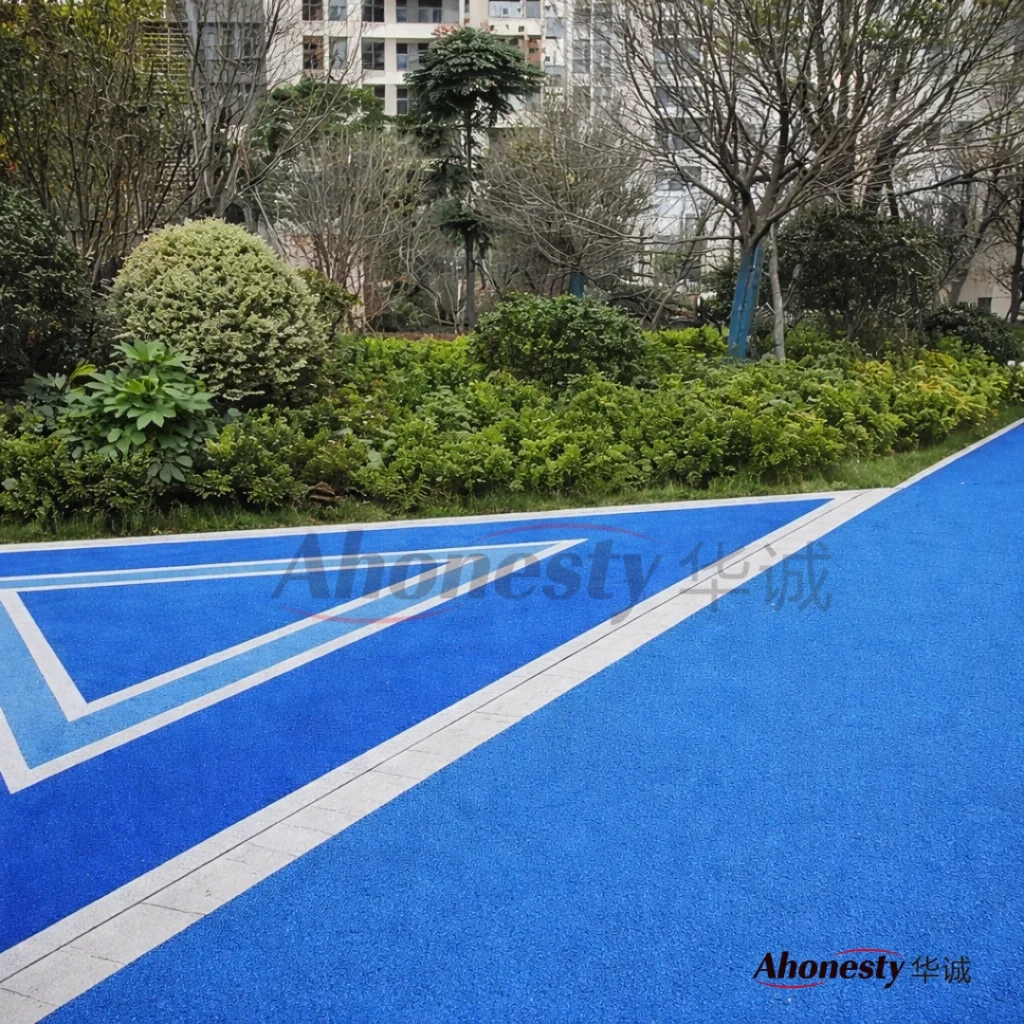
In the cases you provided—linear blue walkways, pavements with directional zoning, curved paths, or patterned surfaces—the priority is consistently order and controllability, not extreme load-bearing capacity.
Hot-mix systems, however, are designed for a very different purpose: continuous, large-scale, centralized construction.
When these two logics are applied to the same project, friction is almost inevitable.
Cold mix colored permeable asphalt did not emerge to “replace” hot mix
What prompted us to reconsider cold-mix systems was not a comparison of technical parameters, but repeated confirmation in real projects.
In pedestrian systems built in segments, cold mix allows construction schedules to align with the site itself.
In pavements requiring precise edge control and patterns, it makes execution more predictable.
In projects that span seasons, it reduces dependence on narrow construction windows and makes planning more realistic.
These advantages rarely appear as individual line items in a data sheet,
but they are immediately felt as a project moves forward.
Cost differences are often only understood after the project is finished
Many projects only realize in hindsight that the perceived “material cost difference” was never the decisive factor.
In small, fragmented projects, what tends to escalate is organizational cost:
waiting, coordination, repeated mobilization, and the risks associated with them.
When the construction system becomes lighter, overall project costs naturally settle into a more rational range.
This is why, in similar scenarios, cold mix colored permeable asphalt often results in a more balanced total cost structure.
It is important to clarify where this logic does not apply
For road sections subject to long-term heavy traffic, frequent sharp turning, and high shear forces, the discussion shifts into structural design and long-term load performance.
In such cases, material selection must be evaluated within a complete road engineering system, rather than based on color, permeability, or construction convenience alone.
Stating this limitation does not weaken the earlier conclusions—it makes them more credible.
A gradually formed understanding
Looking back, many issues in colored permeable asphalt projects were not caused by incorrect material choices,
but by a construction system that did not match the actual scenario.
As projects become smaller, more fragmented, and more detail-oriented,
continuing to rely on systems designed for large-scale continuous construction deserves reconsideration.
The value of cold mix colored permeable asphalt is not simply in its appearance or cost,
but in its ability to bring these very real projects back into a state that is organized, controllable, and deliverable.
This conclusion was not written in advance.
It was shaped—slowly and repeatedly—by real project experience.