
Why garage floors often become a concern after they are put into use
In parking garages, surfaces often look complete long before they are truly proven.
The first concerns rarely arise during construction.
They surface months later—after handover—when moisture accumulates, tyre marks appear, skid resistance feels inconsistent, or maintenance becomes more difficult than expected.
Garages are demanding environments by nature:
·constant vehicle movement
·frequent wet conditions
·high liability for slips and falls
·limited tolerance for long shutdowns or rework
Yet anti-skid flooring in garages is still often treated as a single product decision.
From our experience, this is where many long-term problems begin.
Anti-skid is not a number—it is a long-term behaviour
Anti-skid performance is often discussed in terms of initial friction values or test results.
While those metrics matter, they describe only a moment in time.
In real garages, performance is shaped by:
·moisture migrating through concrete
·abrasion from tyres and foot traffic
·contamination from oils and dust
·gradual surface wear and cleaning cycles
In our view, anti-skid performance in garages is not a static property—it is a behaviour over time.
If that behaviour is not designed into the system from the start, initial performance quickly loses relevance.
A real operating environment: Kaili Times Square parking garage
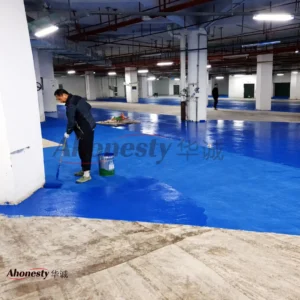
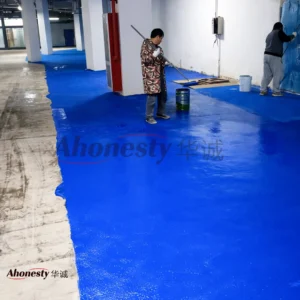
The Kaili Times Square parking garage in Guizhou is a typical example of where this challenge becomes visible.
It is a large, functional underground space:
·designed for daily vehicle circulation
·exposed to humidity and seasonal moisture
·required to balance safety, cost control, and construction efficiency
This is not a showcase surface.
It is an operating system.
In such environments, relying on a single anti-skid layer means accepting uncertainty—especially when substrate conditions, usage intensity, and maintenance schedules cannot be perfectly controlled.
Why single-layer anti-skid solutions often struggle in garages
A single anti-skid layer is usually expected to solve multiple problems at once:
·adhesion to the substrate
·resistance to moisture
·stable skid performance
·surface durability and cleanability
In practice, this places too much responsibility on one layer.
When moisture migrates from below, adhesion becomes the first risk.
When tyres and cleaning gradually wear the surface, skid performance changes.
When contamination builds up, maintenance challenges appear.
This is not a product failure—it is a system design limitation.
A system approach: what each layer is really responsible for
In the Kaili project, anti-skid performance was treated as a layered system, not a single coating.
Primer: stabilising the interface
The role of the primer is not simply “better adhesion”.
In a garage environment, it serves to:
·stabilise variable concrete substrates
·reduce uncertainty at the interface
·prevent moisture-related stress from accumulating beneath the surface
By controlling the most unpredictable layer—the base—the system gains a stable foundation.
Waterborne polymer anti-skid layer: adjustable safety, not fixed texture
The waterborne polymer anti-skid layer provides the functional surface, but its real advantage lies in adjustability.
By using inorganic composite aggregates with different average particle sizes, surface roughness can be tailored:
·higher traction in ramps and turning zones
·balanced texture in parking and pedestrian areas
This allows skid resistance to be designed by zone, rather than forced into a single compromise across the entire garage.
Clear coat: preserving performance, not just appearance
The clear coat is often misunderstood as a cosmetic addition.
In a working garage, its real role is to:
·slow down performance degradation
·improve resistance to water, stains, and contamination
·make long-term behaviour more predictable
Rather than adding performance, it protects the performance already designed into the system.
Why “simple application” is part of system reliability
Large garages impose practical constraints:
·tight schedules
·large surface areas
·varying site conditions
A system that requires highly specialised application or complex training increases variability and risk.
In this context, simple, repeatable application becomes a technical advantage, not a compromise.
Lower training thresholds and consistent execution reduce:
·uneven performance
·accumulated application errors
·long-term maintenance uncertainty
System reliability is not only about materials—it is also about how reliably those materials can be applied.
The overlooked benefit: predictable maintenance over time
From an operational perspective, the true value of a system approach is not perfection—it is predictability.
When anti-skid flooring is designed as a system:
·wear patterns are more uniform
·repairs are easier to integrate
·maintenance planning becomes clearer
This matters far more to garage operators than marginal differences in initial performance metrics.
Rethinking garage anti-skid: from surface choice to operating system
Parking garages reveal a broader truth:
Anti-skid flooring is not just a surface decision—it is part of an operating system that must perform under real conditions, for years.
When anti-skid is treated as a system:
·responsibilities are properly distributed
·failure risks are reduced
·long-term outcomes become easier to manage
Products are components.
Systems are the solution.
And in environments as demanding as parking garages, this distinction makes all the difference.